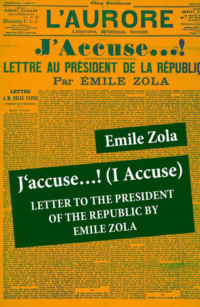
Buch lesen: "J'accuse…! (I Accuse): Letter to the President of the Republic by Emile Zola (Unabridged)"
Emile Zola
J'accuse…! (I Accuse): Letter to the President of the Republic by Emile Zola
(Unabridged)
Imprint:
Cover image: portrait of Émile Zola by Édouard Manet (1832–1883)
Translation by Wikisource (This translation is licensed under the terms of the GNU Free Documentation License)
e-artnow, 2021
EAN 4064066446857
Table of Contents
Imprint Page
I Accuse...!
Letter to Mr. Félix Faure, President of the Republic
I ACCUSE...!
Table of Contents
Letter to Mr. Félix Faure, President of the Republic
Mr. President,
Would you allow me, in my gratitude for the benevolent reception that you gave me one day, to draw the attention of your rightful glory and to tell you that your star, so happy until now, is threatened by the most shameful and most ineffaceable of blemishes?
You have passed healthy and safe through base calumnies; you have conquered hearts. You appear radiant in the apotheosis of this patriotic festival that the Russian alliance was for France, and you prepare to preside over the solemn triumph of our World Fair, which will crown our great century of work, truth and freedom. But what a spot of mud on your name — I was going to say on your reign — is this abominable Dreyfus affair! A council of war, under order, has just dared to acquit Esterhazy, a great blow to all truth, all justice. And it is finished, France has this stain on her cheek, History will write that it was under your presidency that such a social crime could be committed.
Since they dared, I too will dare. The truth I will say, because I promised to say it, if justice, regularly seized, did not do it, full and whole. My duty is to speak, I do not want to be an accomplice. My nights would be haunted by the specter of innocence that suffer there, through the most dreadful of tortures, for a crime it did not commit.
And it is to you, Mr. President, that I will proclaim it, this truth, with all the force of the revulsion of an honest man. For your honor, I am convinced that you are unaware of it. And with whom will I thus denounce the criminal foundation of these guilty truths, if not with you, the first magistrate of the country?
*
First, the truth about the lawsuit and the judgment of Dreyfus.
A nefarious man carried it all out, did everything: Lieutenant Colonel Du Paty de Clam, at that time only a Commandant. He is the entirety of the Dreyfus business; it will be known only when one honest investigation clearly establishes his acts and responsibilities. He seems a most complicated and hazy spirit, haunting romantic intrigues, caught up in serialized stories, stolen papers, anonymous letters, appointments in deserted places, mysterious women who sell condemning evidences at night. It is he who imagined dictating the Dreyfus memo; it is he who dreamed to study it in an entirely hidden way, under ice; it is him whom commander Forzinetti describes to us as armed with a dark lantern, wanting to approach the sleeping defendant, to flood his face abruptly with light and to thus surprise his crime, in the agitation of being roused. And I need hardly say that that what one seeks, one will find. I declare simply that commander Du Paty de Clam, charged to investigate the Dreyfus business as a legal officer, is, in date and in responsibility, the first culprit in the appalling miscarriage of justice committed.
The memo was for some time already in the hands of Colonel Sandherr, director of the office of information, who has since died of general paresis. “Escapes” took place, papers disappeared, as they still do today; the author of the memo was sought, when ahead of time one was made aware, little by little, that this author could be only an officer of the High Comman and an artillery officer: a doubly glaring error, showing with which superficial spirit this affair had been studied, because a reasoned examination shows that it could only be a question of an officer of troops. Thus searching the house, examining writings, it was like a family matter, a traitor to be surprised in the same offices, in order to expel him. And, while I don’t want to retell a partly known history here, Commander Paty de Clam enters the scene, as soon as first suspicion falls upon Dreyfus. From this moment, it is he who invented Dreyfus, the affair becomes that affair, made actively to confuse the traitor, to bring him to a full confession. There is the Minister of War, General Mercier, whose intelligence seems poor; there are the head of the High Command, General De Boisdeffre, who appears to have yielded to his clerical passion, and the assistant manager of the High Command, General Gonse, whose conscience could put up with many things. But, at the bottom, there is initially only Commander Du Paty de Clam, who carries them all out, who hypnotizes them, because he deals also with spiritism, with occultism, conversing with spirits. One could not conceive of the experiments to which he subjected unhappy Dreyfus, the traps into which he wanted to make him fall, the insane investigations, monstrous imaginations, a whole torturing insanity.
Die kostenlose Leseprobe ist beendet.