
0+
Contextual Emotion

Über das Buch
We implicitly trust our ability to read the emotions of others. If someone looks sad, we believe their face tells the objective truth. However, human facial expressions are far less concrete than we realize, heavily heavily manipulated by the environment surrounding them.
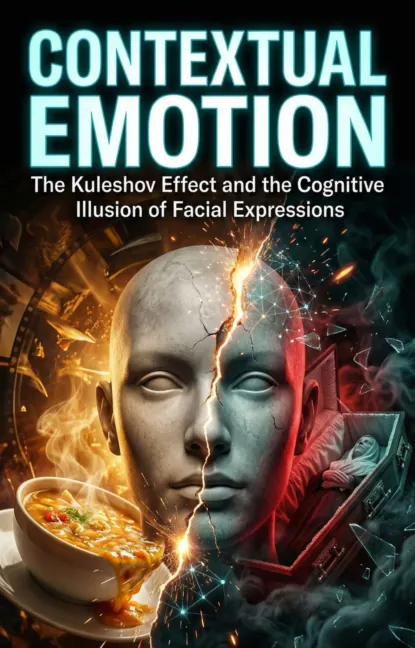
In the 1910s, Soviet filmmaker Lev Kuleshov demonstrated this with a groundbreaking experiment. He took an identical, expressionless shot of an actor's face and alternated it with images of a bowl of soup, a child in a coffin, and an attractive woman. Audiences praised the actor's profound performance, seeing hunger, deep grief, and lust—despite the face remaining completely unchanged. The emotion did not exist on the screen; it was projected entirely by the viewer's brain based on context.
This book deconstructs the hidden cognitive architecture of the Kuleshov Effect. We explore how this optical and emotional illusion dictates everything from political propaganda and modern social media feeds to the way we misinterpret texts and emails from our partners.
By uncovering the mechanics of visual context, you will learn to spot the invisible cues that manipulate your feelings. Understand how your brain actively authors the emotions of others, and reclaim the power of objective observation.